© Beyn Theater Group 2010 - 2026
All Rights Reserved
All Rights Reserved


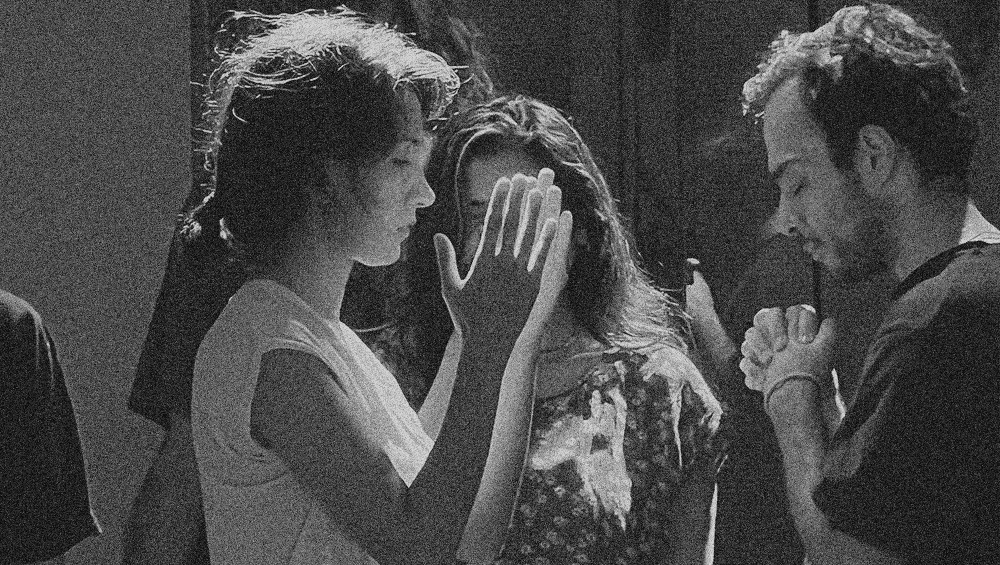
Our theatre begins in encounter: between voices, perspectives, cultures, and experiences. We seek performances that listen as much as they speak, that challenge hierarchies and prejudices, and that remain open to contradiction and change. What moves us, what remains unheard, and what is discovered through dialogue shape our work. Theatre becomes a space for expression, understanding, and the continual reimagining of ourselves and others.

The vital essence of music shaping our performative expressions.
Breaking hierarchies; making space for many voices to be heard.
From rehearsal room to distant cultures, theatre beings by meeting the other.

Theatre making at Beyn is guided by a framework that structures the creative process while remaining open to discovery and transformation. Rather than separating research, creation, and performance into distinct activities, this framework understands them as interconnected stages of a continuous dialogue between text, performers, directors, designers, and audiences. Through this process, ideas are investigated, performances are devised, and theatrical meaning is continuously developed and refined.
The framework unfolds through four stages:
Each project begins with a text that resonates with our contemporary concerns. From this text, the group identifies an overarching dramaturgical idea that connects the work to the present moment and guides the exploratory process. Through research, skill development, dramaturgical inquiry, and collective dialogue, members approach this idea from different perspectives, relating it to personal experience, contemporary realities, and artistic practice. This stage cultivates a shared field of questions, insights, and possibilities that will inform the creative process. Initial ideas for costume, scenic, and lighting design also emerge through these explorations and develop alongside the project's dramaturgical inquiry.
The materials gathered during the Preparations stage are brought into practice through scene-by-scene improvisation of the text. Guided by the project's overarching dramaturgical idea, performers explore each scene while drawing upon the skills, research, perspectives, and experiences developed earlier. Throughout the process, they navigate a space between themselves and the characters they portray, allowing personal experiences and artistic discoveries to enter into dialogue with the narrative of the play. The directorial group actively observes and guides the work, helping maintain focus while encouraging new possibilities to emerge. Costume, scenic, and lighting concepts are further developed in response to the discoveries made during rehearsals and the evolving performance draft. The result is a complete and expansive performance draft containing multiple interpretations, narrative lines, and performative possibilities.
The expansive material generated during the Improvisations stage is reviewed, selected, and organized into a coherent performance. In this stage, the directorial group plays a central role in shaping the final dramaturgy, refining the project's overarching idea into a focused theatrical statement. Narrative trajectories are refined, the relationship between performer and character is carefully shaped, and the emerging performance is evaluated against its intended artistic aims.
As the script is revised through adaptation, omission, reordering, and rewriting, the performance's physical, vocal, musical, and visual elements undergo a parallel process of refinement. Actions, rhythms, interactions, images, and stage compositions are distilled and arranged into a coherent performative language. Costume, scenic, and lighting design are integrated into this process and take their final form in relation to the dramaturgy, rhythm, and visual composition of the production. The result is a second draft that closely resembles the final production in both structure and intention.
For us, a performance cannot be fully realized in isolation from its audience. The creative process continues through public presentations, where the performance is tested in practice. Particular attention is given to its rhythm and how it operates on the audience: how attention is guided, how meanings emerge, and how the performance is experienced as a whole. The insights gained through these encounters inform the final adjustments to the production.
At the same time, finalizing is understood as an unattainable horizon. Much like a limit point in mathematics, a performance can move ever closer to completion through refinement and repetition, yet it can never arrive at an absolute final form. Each presentation is therefore both a performance and a continuation of the creative process. Costume, scenic, and lighting elements are likewise tested in performance and may be adapted in response to audience encounters, spatial conditions, or unforeseen circumstances.


"Despite all claims about its nature, the Beyn Theatre Group is, at its core, a theater group. Any discourse on its nature that does not center its technical theatrical foundations will fall into an abyss of endless and pointless interpretations—interpretations that destroy the possibility of historicization."
Founded in 2010 and based in the heart of Tehran, Beyn Theatre Group understands its work as inseparable from the life of the city and the people who inhabit it. Our performances are shaped by the rhythms, tensions, contradictions, and diverse experiences that coexist within contemporary Tehran. Living and creating in this environment has influenced not only the subjects we pursue, but also our approach to theatre and performance-making.
Over the years, this continuous dialogue with Tehran has gradually given rise to the overarching concern of our work: the tragedy of contemporary human. This inquiry reflects our attempts to understand the uncertainties, vulnerabilities, and resilience that characterize contemporary life. While this concern has remained a
common thread throughout our projects, each work has sought to articulate it through more specific questions and experiences. Themes such as violence, discrimination, the corruption of power, and other manifestations of the contemporary condition have emerged as particular expressions of this broader inquiry.
For us, theatre is not separate from the realities in which it is created. The atmosphere of Tehran and the experiences of those who live within it have become a crucial presence in both our artistic process and our understanding of performance. In this sense, our work seeks to remain attentive to the pulse of the city and to reflect upon what it means to live, imagine, endure, and create within our time.