© Beyn Theater Group 2010 - 2026
All Rights Reserved
© Beyn Theater Group 2010 - 2026
All Rights Reserved


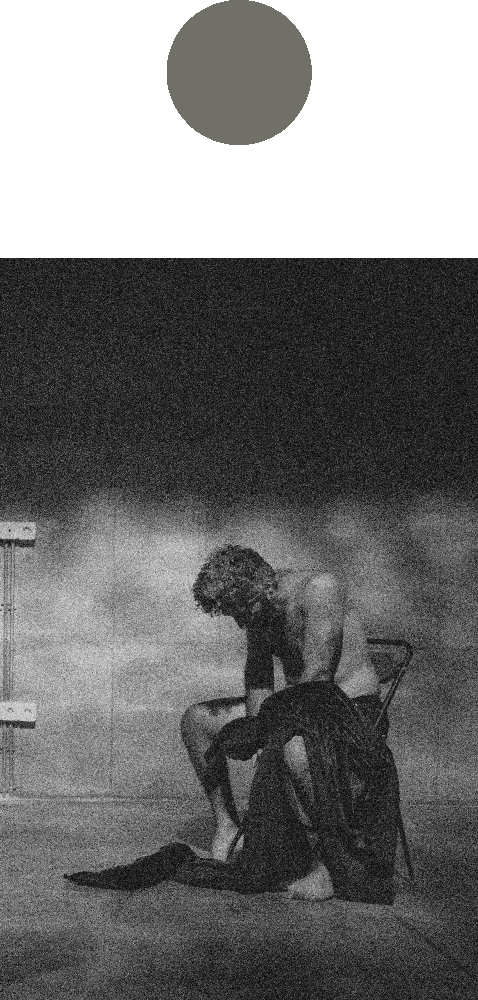
The Macbeth Project
Beyn Theatre Group's engagement with Shakespeare's tragedy spans more than a decade, returning to the same text with different hands, different questions, and different urgencies. Like all of the group's projects, the exploration on Macbeth has been guided by Beyn Theater Group’s overarching concept: The Tragedy of Contemporary Human. It is this concept that explains why, each time the group returned to Shakespeare's text, the atmosphere of the surrounding society became so central to how the material was read and remade.
The First Macbeth (2013–2014)
The project's origins lie in early 2013, when a few members of the group began gathering to rehearse in an old abandoned kindergarten building in Yakhchal street, north of Tehran. The rehearsals later moved to the old houses of Moniriyeh, a historic neighborhood in central Tehran, and eventually to Shahran, in the northwest of the city — a relocation that coincided with a shift in the group of performers carrying the project forward. The dramaturgical starting point throughout remained, at once, classical and unmistakably contemporary: the rise and fall of a tyrant, read against the political atmosphere of Iran at the time.
The rehearsal process explored flow art and juggling as tools for developing physical precision and presence, alongside an immersion in Nordic music that shaped the production's sonic world. These explorations eventually moved into public space through open rehearsals in Laleh Park, giving rise to the parallel Part-Up project.
In early 2014, this first version of Macbeth entered the 32nd International Fajr Theatre Festival, receiving nominations for best music and best set design. The production was performed only twice, both within the festival. Brief as this moment was, it planted something that would lie dormant for nearly a decade before being taken up again with renewed force.
Macbeth Reconstructed (2023–2025)
When Beyn Theatre Group returned to Macbeth in 2023, the world it was returning from had changed profoundly. The Woman-Life-Freedom movement had swept through Iran, and the group came back to Shakespeare's text with a new dramaturgical concept.
The core idea of this version, Macbeth Reconstructed, was the same one that would later drive My Macbeth: a reading of the witches in parallel with the often-ignored history of medieval women persecuted for holding different beliefs — a parallel that felt deeply appropriate to the atmosphere of Iran at the time — pursued through the disruptive energy of the carnivalesque form. At this stage, however, the shape that the witches would ultimately take, and the way the performance would resolve, remained open questions, still being discovered through the process itself. Transmitting theatrical experience to a new generation of performers and practitioners was an important goal that ran alongside this dramaturgical search — the performers involved were drawn largely from the group's own workshops, bringing fresh perspectives and an unmediated relationship to the contemporary moment.
The conditions under which Macbeth Reconstructed was made were themselves a form of statement. Across nearly two years, the group moved through a striking range of spaces scattered through the city — Kakhe Honar, Tamrin Space, Karestan Art Complex, the Farvardin building, Aban Hall in the center of Tehran, and the 404 building in Jordan — each carrying its own character, history, and atmosphere. This continual movement through Tehran became a kind of exploration in its own right: the city itself, in its variety and unevenness, offered a different environment for each phase of rehearsal, and the group allowed these shifting surroundings to inform the texture and direction of the work.
The most significant achievement of Macbeth Reconstructed was not a finished production in the traditional sense, but a process: approximately a year of open rehearsals, conducted with consistency and commitment, that invited participants and witnesses into the making of the work rather than only its presentation. This extended, porous rehearsal period culminated in a single performance, staged not in a theatre but in a jungle in the mountains north of Iran, in a place called Alimestan — theatre that attempted to grow from its landscape rather than being transplanted into it. The performance found a handful of unplanned witnesses there too: hikers passing through and local rural residents, invited on the spot to watch, lending the evening a quality of encounter that neither the group nor its audience could have anticipated. At its core, Macbeth Reconstructed was a search for the most natural conditions of performance: a mode of making theatre that responds organically to the identity of the place in which it occurs, the people who make it, and the people who receive it.
Running in parallel with this work, and growing from the same moment of social urgency, another strand of the Macbeth project took shape: the Resilience project, a paratheatrical response to the collective psychological weight of the post-uprising period. Resilience first reached its audience in 2025, standing as a companion piece to Macbeth Reconstructed.
My Macbeth (2025–present)
By the middle of 2025, the Macbeth project entered its third phase. My Macbeth brought together an ensemble combining some of the performers who had been present in Macbeth Reconstructed with new members. In this version, a solid dramaturgical vision was already shaped based on previous experiments: an understanding about how the structures of power corrupt and ultimately ruin any hope for meaningful change — and, just as crucially, of how that recognition does not stop people from trying again. Hope, the group had come to understand through the years of working on this material, is not something easily taken away.
Shaped by the Woman-Life-Freedom movement, the production recentered the witches as its moral and political core, reimagining them not as supernatural agents of chaos but as women who had grown tired of corruption, violence, and political indifference — women who sought, through Macbeth's rise, a transformation that power itself would ultimately betray. Rather than a simple opposition of good and evil, My Macbeth became an investigation into the tragic repetition of political history: genuine hope giving way, again and again, to the very violence it sought to overcome.
The production ran in the Karestan Art Complex for roughly two months, spanning the closing days of 2025 and the early weeks of 2026, performing three to four nights a week, until the outbreak of war brought the run to a halt. Now, in the middle of 2026, the group continues to watch and wait, ready to pick the work back up the moment circumstances allow.
The Arc of a Project
Taken together, the productions and processes that constitute the Macbeth project trace an arc inseparable from the history of the society in which they were made — from the early explorations of flow art and Nordic music in the old houses of Moniriyeh, through the rehearsals in different places and forest performance of Macbeth Reconstructed, to the still-unfolding run of My Macbeth. It is, in this sense, not only an artistic project but a record of a group's attempt to stay present, stay honest, and keep making theatre in circumstances that have repeatedly demanded both courage and reinvention.