© Beyn Theater Group 2010 - 2026
All Rights Reserved
© Beyn Theater Group 2010 - 2026
All Rights Reserved

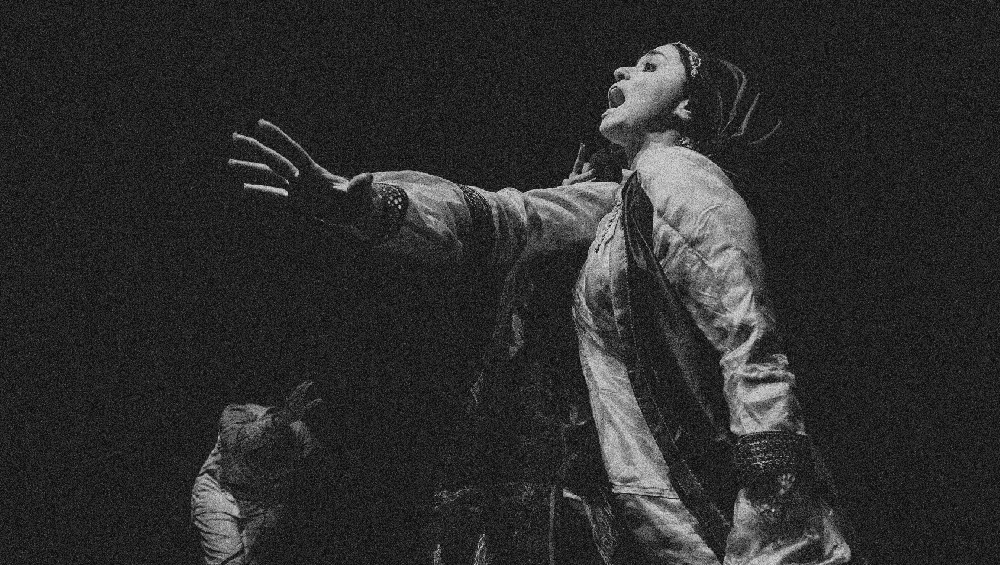
The Medea Project
Every group has an origin point — a project before which there was no group, and after which there could be no other path. For Beyn Theater Group, that point is Medea.
Beginnings (2010)
The story begins in early 2010, before Beyn Theater Group had a name. A loose gathering of young theatre makers and practitioners — many of them students connected to Sharif University of Technology's Centre of Theatre, alongside others from Tehran University of Art — came together around a shared, still-undefined question: what makes a stage presence feel alive? Inspired by the work of Gardzienice and Teatr Piesn Kozla, the group began testing techniques borrowed from others, then slowly building rehearsals and training methods of its own, searching for a way of making theatre that felt less like a fixed product and more like a living, breathing organism — a spectacle to feast the eyes and ears.
From the outset, three elements stood at the center of this search: stage presence, musicality, and physicality, bound together by the communication between performers. Everything the group explored in this period was, in one way or another, in service of bringing stage presence to its fullest expression. It was here, in this formative searching, that the principles which would define Beyn Theater Group's later work first began to take shape. Medea was not simply the group's first production — it was the project through which the group itself came into being.
Early Performances and Festivals (2011–2012)
In 2011, Medea entered both the Iran International University Theatre Festival and the International Fajr Theatre Festival, marking the production's first public exposure. A year later, in 2012, the performance reached a wider audience through public performances at Molavi Hall — a moment that introduced something genuinely new into the Iranian theatrical landscape of the time. The musicality of the piece, built from Iranian folk lullabies and the ritual music of the Zar tradition, combined with a physicality honed through extensive rehearsal, to produce a quality of stage presence that felt unfamiliar within the conventions of the period.
Between the festival appearances and the Molavi Hall performances, the production underwent what the group would come to call its finalizing process — a structured period of refinement focused on the montage of direction and the montage of the performers' journey through the piece. This period of work also marked the group's first ventures into unconventional spaces: rehearsals were held in an old, abandoned house on Dabestan Street in eastern Tehran, and later in another abandoned house on Dowlat Street, in the city's northeast. The group also staged a performance of Medea in the deserts of Kashan, carrying the production into a landscape entirely removed from any theatre.
As a founding project, this period was not without friction. The process was full of decisions about structure, content, and concept — decisions that came, inevitably, with heated argument, struggle, and conflict. Yet even amid this difficulty, one choice remained clear and deliberate from the start: the decision to work with Medea was a conscious reflection of the group's deep concern for women and the discrimination they face, a concern that would continue to surface throughout the group's later work.
International Exposure (2015–2017)
In 2015, the group traveled to Poland to perform at Gardzienice and the Grotowski Institute — an experience that proved profound, not only for the performances themselves but for the gatherings and conversations that followed them. These exchanges gave the group a clearer understanding of the journey it had been on for several years, and encouraged it to keep pushing into unexplored territory.
Two years later, in June 2017, Medea was presented at the Babel Festival, where it earned the award for Best Performance, and Sara Akbari received the award for Best Actress. By this point, shaped by years of accumulated refinement, the production had evolved into its strongest version yet — a culmination of everything the group had built since those first rehearsals in an abandoned house in eastern Tehran.
The Exchange Project (2016–2017)
In 2016, a subproject of Medea took shape at Qashqaii Hall under the name Exchange Project. Conceived as an extended inquiry into how theatrical experience might be shared and transmitted, the project unfolded as a series of workshops, gatherings, and lectures, bringing the group into direct dialogue with other groups and individuals about the ways their respective practices, methods, and discoveries could be exchanged. The initiative reflected something the group had come to understand through years of its own internal struggle to build a performance language from scratch — that such knowledge is rarely complete in isolation, and gains depth precisely through this kind of exchange with others walking parallel paths.
Medea itself was performed again during the days of the Exchange Project, woven into this broader gathering of workshops and conversations. The performance earned the group a prize at the Theatre House celebration in early 2017, a recognition that arrived directly out of the renewed energy and reflection the Exchange Project had generated — energy that, alongside the international experience in Poland, would carry the production into the celebrated version that triumphed at the Babel Festival.
Legacy
Medea remains, to this day, part of Beyn Theater Group's active repertoire. It stands as the group's first production and, in a deeper sense, as the record of its struggle to hone the craft of theatre-making from nothing. From the gatherings in Gardzienice to the dialogues of the Exchange Project, the production was shaped as much by what the group brought into the world as by what the world, in turn, gave back to it. More than a decade after its first rehearsals, Medea continues to function as the group's laboratory — a space for ongoing exploration, and a vessel for transferring and exchanging experience with each new generation that joins the work.