© Beyn Theater Group 2010 - 2026
All Rights Reserved
© Beyn Theater Group 2010 - 2026
All Rights Reserved

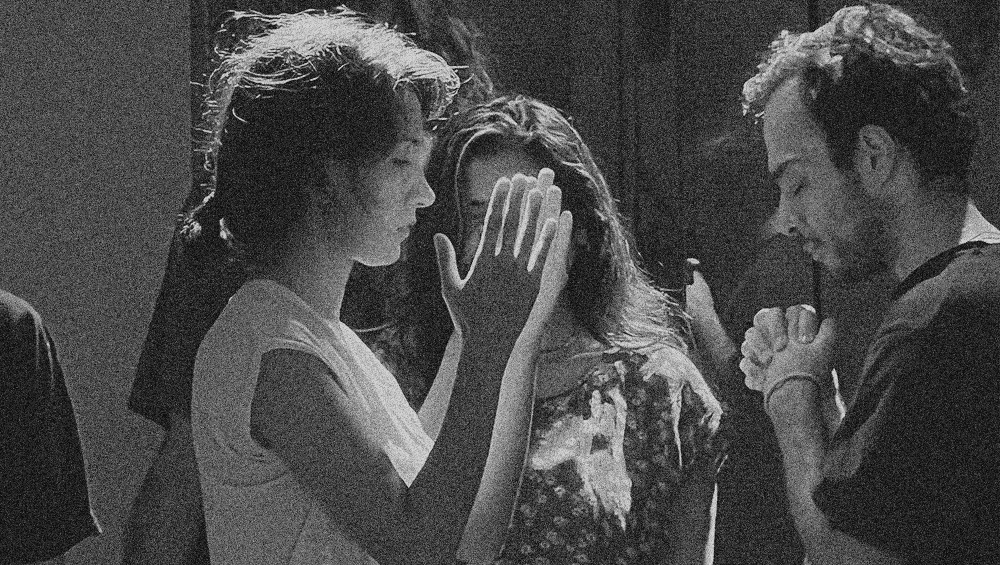
The Hamlet Project
Some questions are not meant to be answered quickly, and the Hamlet Project has, since its earliest days, been one long act of staying with such a question rather than rushing past it. The project is still underway — not stalled, but moving through the ordinary rhythm of any long inquiry: stretches of discovery followed by stretches of confusion, each one, in its own way, teaching the group something it could only have learned by living through it. The destination remains the same one the group set out toward from the beginning: a main performance, accompanied by a set of sub-performances that grow out of and around it — the working method Beyn Theater Group has come to rely on across all of its projects.
An Inherited Question (January 2022)
The project began with a meeting at Rad Café in January 2022, with rehearsals following the next month at Barg Institute, in central Tehran's District 6. From its earliest sessions, the group committed itself to exploring verticality and stage presence — concepts drawn directly from the documented practice of Jerzy Grotowski and Thomas Richards at their Workcenter in Pontedera, and tied as well to lines of thought running through Antonin Artaud's theatre theory and the practices of Eugenio Barba. The central inquiry was how an experience of performance, for doer and spectator alike, might be made deeper and more profound, and what particular qualities or dimensions such profoundness might actually take.
This pursuit took shape under the working title Emancipated Hamlet — a name born from the group's own need, at the time, to be emancipated from the fear, darkness, and isolation that the COVID-19 period had imposed on collective life.
Toward Presence (February–September 2022)
Grounded in reports and accounts of the Pontedera research, alongside the related insights of Artaud and Barba, the group's early work centered on verticality understood in Grotowski's own sense of the term: an inner energetic and bodily presence cultivated by the doer, oriented less toward outward representation than toward an internal process. The goal was never a single collective transformation shared identically by everyone in the room. Rather, the group sought to manifest, through this presence, a particular kind of situation — one in which each doer and each member of the audience might encounter their own individual change, their own elevation, on their own terms. Through physical, vocal, and gestural training built around this aim, the doers began to develop a tangible shift in their own bodily and energetic presence — though whether this fully constituted the verticality the group had set out to find, or something closer to its edge, remains an open question the group has never tried to resolve with false certainty.
Rehearsals continued along this line at Barg Institute, with the ordinary turnover of a long process — some performers arriving, others stepping away — until September 2022, when the killing of Mahsa Amini and the Woman-Life-Freedom movement that followed brought the work to a halt.
A Text That Seemed Not to Fit (May 2023)
The group resumed in May 2023, picking up the thread where it had been left — now working out of Tamrin Space, an old house in central Tehran's District 11 that had since been rebuilt for artistic practice. Each doer, by this point, had found an individual way of sustaining the quality of presence the project was built around. But one problem had still gone unaddressed: none of this training was yet attached to anything resembling a theatrical production. A dramatic structure was needed to give the work a shape beyond pure practice.
Drawing on methods developed during the Prometheus Project, Shahab Agahi and Meysam Khoei devised a text based on Hamlet. What followed surprised the group. Despite having cultivated the capacity to move and speak freely while sustaining the presence they had worked so hard to develop, the encounter with this new text simply would not cohere — not because the text itself was unworkable, but because the group had not yet found the particular skill or force required to bring it into alignment with what the doers had built. The two halves of the project — the inner discipline accumulated over more than a year, and the dramatic material meant to house it — remained, for the time being, apart. Rather than treat this as a dead end, the group set the rehearsals aside and turned to other work, carrying the unfinished problem quietly in the background, as one more difficulty still waiting for its solution.
Solo Narratives and a Collective Weave (Middle of 2025–Present)
In the middle of 2025, the group reopened the Hamlet Project, relocating once more to Karestan Art Complex — another former house in central Tehran's District 11, similarly rebuilt into a space for artistic work — and returning to a method first tested during the Prometheus Project: solo rehearsal. The working idea this time was different. Perhaps the bridge between presence and text lay not in the play itself, but in something more personal — an individual narrative, improvised freely by each performer in dialogue with Hamlet. Over these solo sessions, every performer built her own private version of the story, shaped by her own associations and lived experience.
Once these individual narratives had taken form, the group moved into collective rehearsal, bringing each performer's version into direct contact with the others. Out of this encounter grew a larger collective narrative — not a single fixed story, but a layered fabric woven from personal histories and contemporary experience, one that absorbs Shakespeare's Hamlet almost entirely into itself while telling it from angles the original text never anticipated, refracted through lives lived in a specific place and time.
As of the middle of 2026, the group has entered the improvisational stage of bringing this collective narrative into direct dialogue with the Folio text of Shakespeare's Hamlet. The current aim is to discover what possibilities open up in that encounter — what new material it generates, and what it might ultimately suggest for how the performance, still carrying the working title Hamlet, should be structured. Emancipated Hamlet remains under consideration as well — a potential sub-performance the group is still thinking through, in keeping with its broader practice of building each project around a main production accompanied by smaller, related works.
Where the Project Stands
The Hamlet Project has not delivered a single, conclusive answer to the question that set it in motion in January 2022 — and the group has made peace with not knowing whether such an answer exists at all, or whether it simply hasn't been found yet. What the process has yielded instead, through every pause, false start, and quiet return, is a string of smaller, situated answers: solutions and insights that proved real and useful at specific points along the way, each one carrying forward into the next stage of the work. For now, that is where the group continues to stand — not with a finished theory, but with a living practice, still working through its own ups and downs toward the performance it has been building toward all along.