© Beyn Theater Group 2010 - 2026
All Rights Reserved
© Beyn Theater Group 2010 - 2026
All Rights Reserved

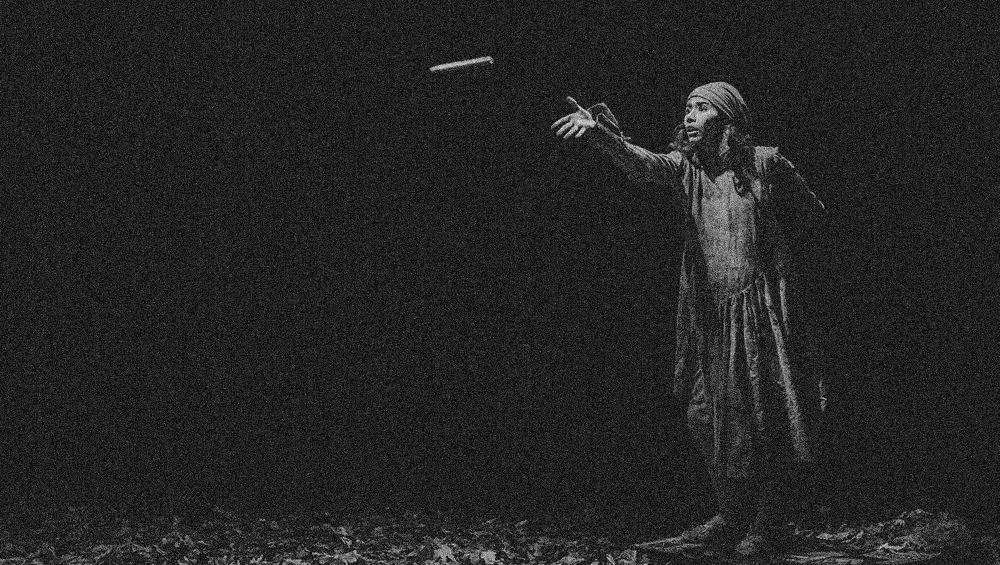
The Prometheus Project
Some texts resist being chosen, and the doubt surrounding their selection can become as formative as the texts themselves. This was true of the Prometheus Project, whose early uncertainty gave rise to an idea that would go on to define the group's work for years afterward.
Beginnings and Doubt (Early–Mid 2017)
Following the Fajr Festival run of When We Dead Awaken, the group began looking toward its next undertaking, with rehearsals commencing in February 2017. Yet the choice of source material remained unresolved for some time. The hesitation was not superficial; it stemmed from structural and conceptual questions the group had been wrestling with for a while, concerning what kind of text could properly hold the inquiries Beyn wanted to pursue.
To work through this impasse, the group convened an extended series of meetings — discussions that addressed not only the question of which text to pursue, but a deeper question of authority within the group itself: who has the standing to decide, and on what basis. It was within these very discussions that one of the group's most lasting concepts took form: the Tragedy of Contemporary Human, an overarching inquiry that would come to color the group's earlier work in retrospect and shape every project that followed it. By April 2017, the group had settled on Aeschylus' Prometheus Bound as the foundation of its next production, a text that seemed equipped to carry this newly articulated concern forward.
Khane Tarbiat and the Birth of And/Or/Pro/Methe (April–August 2017)
Rehearsals got underway at once in Plateau 60s, a space in central Tehran. From the start, the process moved along two simultaneous tracks. Solo rehearsals ran in parallel with collective sessions, each performer using individual exploration to draw out and enrich her own personal material, while the group as a whole worked through contemporary dance and physical movement. Neither track preceded the other; the two ran side by side, continually feeding and sharpening one another — a deliberate working method the group adopted to deepen both dimensions of the process at once. The collective sessions, in particular, drew on a fluency in musical improvisation the group had already cultivated through earlier projects, and were further enriched by the fact that each performer arrived with her own distinct relationship to dance and physicality, lending the rehearsal room a real diversity of bodily language and approach.
Out of this intertwined process came Khane Tarbiat — a title that surfaced spontaneously in the midst of improvisation, tied to the group's growing preoccupation with the oppressive mechanisms embedded within education. Staged in the yard of Plateau 60s in August 2017, the performance was built entirely around this concern.
It was during these same collective rehearsals that the group stumbled upon a discovery that would prove lastingly useful: performers found they could improvise discrete points of the storyline independently, without first needing the entire structure to lock into place. Far from a mere workaround, this turned out to be a genuine skill — one that would go on to sharpen the Improvisation stage of the group's framework considerably, leaving the group noticeably more efficient and self-assured in this part of its process on every project thereafter.
In the aftermath of Khane Tarbiat, a new direction began to crystallize: And/Or/Pro/Methe. Rehearsals continued under this evolving vision, and new performers entered the work.
Yazd and the Rock-Cut Tombs (September 2017)
In September 2017, timed to coincide with Iran's commemorative ceremonies of Moharram, the group traveled to Yazd in search of a direct encounter with the ritual of Nakhl Gardani and the atmosphere surrounding the veneration of a major martyr figure. It was in this encounter that the concept of the Martyr first entered the project in any real sense, introducing a concern the production had not carried before. While there, the group staged a version of And/Or/Pro/Methe inside Yazd's Rock-cut Zoroastrian tombs — an experience the group has since described as among the most extraordinary moments of the entire project.
Fajr and a Roughly Polished Work (October 2017–February 2018)
Back in Tehran, rehearsals resumed at Plateau 60s and continued from October 2017 through January 2018. And/Or/Pro/Methe was presented at the Fajr Festival in February 2018, earning a nomination for the Special Prize in the international section.
The performance's timing carried particular weight: both the festival and the production unfolded against the backdrop of the protests and strikes that had gripped the country that December and January. These events left a visible imprint on the piece's final structuring, leaving it, by the group's own admission, only roughly polished — a condition compounded by the absence of designers and a dramaturge for much of the making process. Even so, the skill discovered earlier during the Khane Tarbiat rehearsals — the ability to improvise individual narrative beats independently — proved indispensable here, allowing the performance to hold its shape even without the structural and dramaturgical support the group would ordinarily have relied upon.
In February 2018, a filmed version of And/Or/Pro/Methe was entered into the MTNow festival, and by April 2018 had been named one of the festival's ten winners.
The Birth of Prometheus/Plague (July 2018–January 2019)
In July 2018, a new text emerged: Prometheus/Plague, written by Meysam Khoei in collaboration with Shahab Agahi. This version grew out of a desire to address dramatic gaps the group had sensed in And/Or/Pro/Methe, and took shape through a deliberate collision of ideas — bringing Aeschylus' Prometheus Bound into direct dialogue with Camus' The Plague. Within this new dramaturgy, murderer and martyr became two faces of a single coin, both ultimately consumed by the same fate. Though it shared its Aeschylean root with And/Or/Pro/Methe, the new text approached that source through an entirely different dramaturgical lens — a pattern that would echo, years later, in the relationship between the original Macbeth production and My Macbeth.
Rehearsals for Prometheus/Plague ran from August through December 2018, culminating in a public run at Chaharsou Hall, City Theatre.In January 2019, the production entered the Fajr Festival, winning the award for Best Music and receiving nominations for Best Directing and Movement Design, Best Actress, Best Costume Design, and Best Makeup.
International Stage and the Idea of Violence and Martyrdom (June 2019–2024)
In June 2019, Prometheus/Plague traveled to the Opera Dagen Festival in Rotterdam, sharing the bill with Orphe/Majnoon, a musical collaboration between Beyn Theater Group and an Italian group. This international chapter, layered onto the project's ongoing inquiry into violence and martyrdom, eventually opened the path toward Rosarium, performed in June 2024 — a work that, though different in form and subject, remains bound to the same overarching concerns and to the same Aeschylean root from which the entire Prometheus Project first grew.
A Strange Echo
There is an unsettling irony buried in the project's central chapter. Prometheus/Plague ends on the suggestion that plague will eventually come for everyone — martyr and murderer alike, both ultimately casualties of the gods' violence. Not long after the production's final performance, the arrival of COVID-19 enacted something disturbingly close to that very prophecy, collapsing the distance between what had been staged and what the world itself was about to live through.